
Every time you make an online payment, log in to your company's email, or store a file on the cloud, someone is working quietly in the background to make sure that data stays safe. That someone is a cyber security professional - and in 2026, India needs a lot more of them.
If you're a student, a fresh graduate, or an IT professional thinking about switching lanes, cyber security probably feels like a big, technical, slightly intimidating field. It doesn't have to be. This guide breaks down what cyber security actually means, the different specializations within it, and the realistic career paths you can take in India - without the jargon.
What is Cyber Security?
Cyber security is the practice of protecting computers, servers, networks, applications, and data from unauthorized access, theft, or damage. In simple terms, it's the digital version of locking your doors, installing CCTV, and hiring a security guard - except the "property" being protected is information, and the "intruders" are hackers, malware, and cybercriminals operating from anywhere in the world.
Cyber security isn't one single job. It's an umbrella term that covers several specialized roles - some people focus on building strong defenses, some focus on thinking like an attacker to find weaknesses before criminals do, and others focus on investigating and responding after something goes wrong. That's exactly why "cyber security" as a career has so many different entry points, which we'll cover below.
Why Cyber Security Matters in India Right Now
India's digital economy has expanded rapidly - UPI transactions, e-commerce, digital banking, cloud-first businesses, and remote work have all become mainstream. Every one of these systems is a potential target. As more Indian businesses, government bodies, and financial institutions move critical operations online, the demand for people who can secure that infrastructure keeps growing.
This demand isn't limited to large IT companies. Banks, healthcare providers, e-commerce platforms, manufacturing firms, and even small businesses now need dedicated security professionals or outsourced security teams. That breadth is what makes cyber security one of the more stable, recession-resistant career choices in IT today - organizations rarely cut security budgets, even when they cut elsewhere.
There's also a structural reason demand keeps rising: attackers only need to find one weakness, while defenders have to secure everything. That imbalance means organizations are continuously hiring, continuously training, and continuously upgrading their security teams - not as a one-time project, but as an ongoing function. For someone building a career, that translates into long-term job security and a clear path for continuous learning rather than a skill set that becomes outdated in a few years.
Core Domains Within Cyber Security
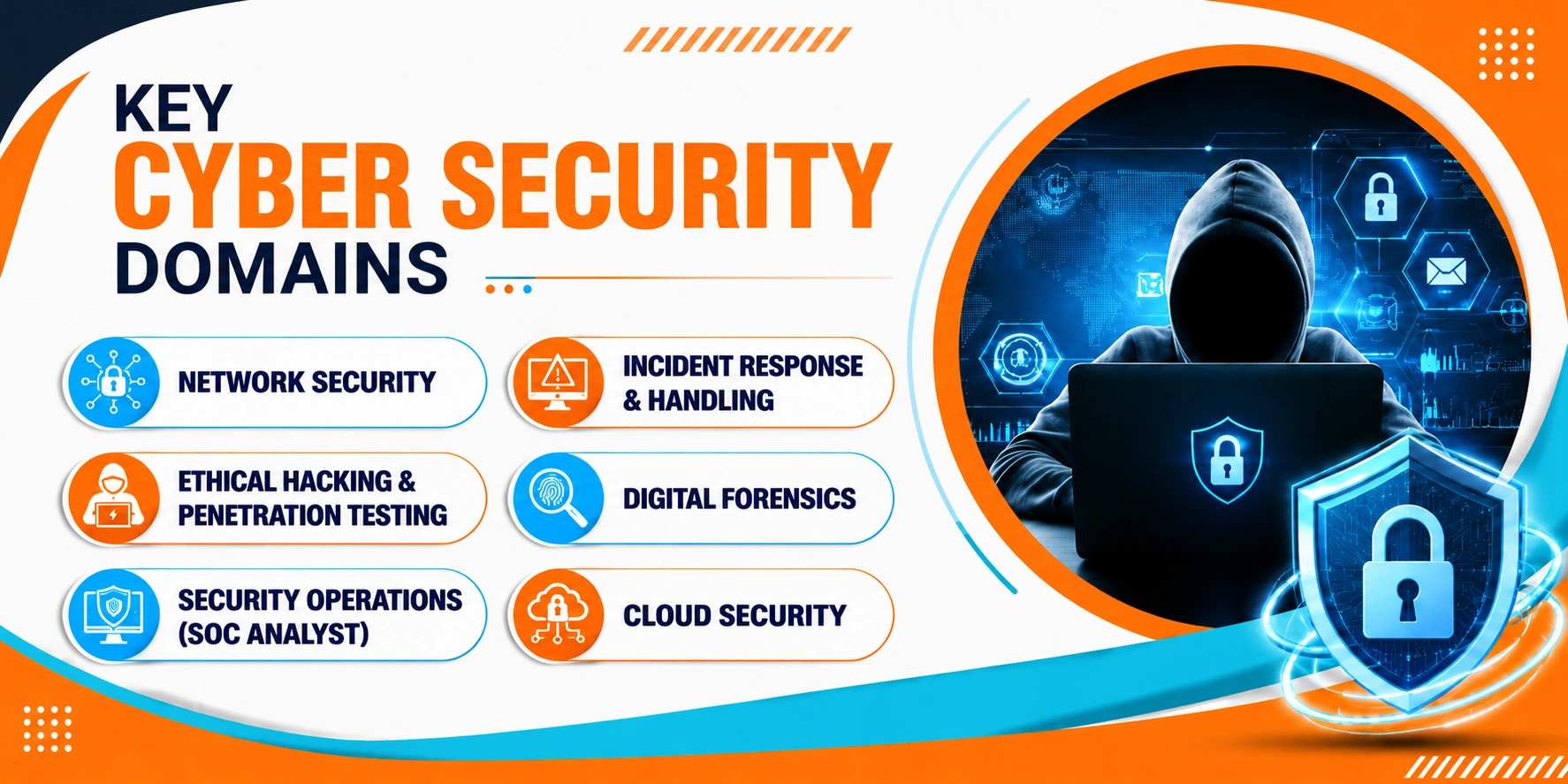
Before choosing a career path, it helps to understand the major domains a beginner can specialize in. Most cyber security careers in India fall into one of these six buckets.
1. Network Security
This is the foundation layer - protecting the pathways data travels through. Professionals here configure firewalls, secure routers and switches, monitor traffic for anomalies, and prevent unauthorized access at the network level. It's often the natural next step for people who already have networking fundamentals (like CCNA).
2. Ethical Hacking & Penetration Testing
Ethical hackers are hired to think like criminals - legally. They simulate real-world attacks on an organization's systems to find vulnerabilities before actual attackers do. This is one of the most in-demand and well-recognized specializations, typically anchored by the Certified Ethical Hacker (CEH) credential.
3. Security Operations (SOC Analyst)
A SOC (Security Operations Center) Analyst monitors an organization's systems around the clock, watching for suspicious activity, analyzing alerts, and escalating genuine threats. It's one of the most common entry-level roles into cyber security because it builds strong foundational monitoring and analysis skills.
4. Incident Response & Handling
When a breach or attack does happen, incident handlers are the professionals who step in to contain the damage, investigate the root cause, and restore normal operations. This role requires a calm, methodical mindset and strong process discipline - it's less about attacking or defending and more about crisis management.
5. Digital Forensics
Digital forensics investigators come in after an incident to reconstruct exactly what happened - analyzing devices, disks, memory, and network logs to trace the attacker's steps. This is a highly specialized skill set that often overlaps with legal and law-enforcement contexts, making it one of the higher-value niches within cyber security.
6. Cloud Security
As more Indian businesses move infrastructure to platforms like Microsoft Azure, cloud security has become its own specialization - securing cloud identities, storage, virtual networks, and access controls rather than traditional on-premise systems.
Cyber Security Career Paths in India: A Realistic Roadmap
One of the most common questions beginners ask is: "Where do I actually start?" Here's a practical, step-by-step path most successful cyber security professionals in India follow.
Step 1: Build IT Fundamentals
Before specializing, it helps to understand how networks and systems work. A basic grounding in networking concepts (IP addressing, routing basics, how data moves) makes every later specialization easier to learn - even if you eventually move into a non-networking role like forensics or SOC analysis.
Step 2: Choose Your Entry Point
Most beginners enter cyber security through one of two doors:
- SOC Analyst track - ideal if you enjoy monitoring, analysis, and pattern recognition. Often the fastest entry-level role to land.
- Ethical Hacking track - ideal if you're naturally curious about how systems break and enjoy hands-on, hacker-mindset problem solving.
Step 3: Get an Industry-Recognized Certification
Certifications matter enormously in cyber security hiring because they validate hands-on capability, not just theoretical knowledge. In India, EC-Council certifications - particularly Certified Ethical Hacker (CEH), Certified SOC Analyst (CSA), and Certified Incident Handler (ECIH) - are among the most globally recognized and employer-trusted credentials in this field.
Step 4: Specialize and Advance
Once you have 1–3 years of experience in an entry-level security role, you can move toward specialization - penetration testing, digital forensics, cloud security, or security architecture - or toward leadership roles like Security Team Lead or SOC Manager.
Skills You Need to Start a Career in Cyber Security

You don't need to be a coding expert to enter cyber security. What actually matters is:
- A basic understanding of how networks and operating systems function
- Comfort with hands-on lab environments and troubleshooting
- Analytical thinking and attention to detail
- A genuine curiosity about how systems can be broken and fixed
- Familiarity with common security tools (learned through structured, lab-based training rather than self-study alone)
These are all learnable skills - which is exactly why cyber security remains accessible to graduates from non-technical or non-coding backgrounds, not just computer science engineers. What separates candidates who get hired from those who don't usually isn't raw talent - it's whether they've practiced these skills in a real, guided lab environment versus just reading about them.
Why Hands-On, Lab-Based Training Matters More Than Self-Study
Cyber security is fundamentally a practical discipline. You can read about firewalls, SIEM tools, and attack simulations for months, but until you've actually configured a firewall rule, analyzed a real SOC alert, or run a controlled penetration test in a lab environment, that knowledge stays theoretical - and theoretical knowledge doesn't clear technical interviews.
This is where structured, accredited training makes a measurable difference. At SiliconUniv, our Cyber Security programs are delivered as an EC-Council Accredited Training Centre, giving students access to the official CEH, CSA, and Certified Incident Handler (ECIH) curricula alongside 24/7 hands-on lab access across our Noida and Karol Bagh centres.
With 20+ years of real industry expertise behind the training and 1600+ students already placed in companies like Infosys, TCS, Wipro, and HCL, the focus stays firmly on job-readiness - not just certification for its own sake.
If you're exploring where to specialize, our Certified Ethical Hacker (CEH), Certified SOC Analyst (CSA), and Certified Incident Handler (ECIH) tracks each map to a different entry point covered in this guide - so you can pick a path that actually fits how you think, not just what's trending.