
When you pay online, attend a video call, or watch a game being streamed live – there is always a network operating behind the scenes. Someone has to develop, maintain, and secure that network. And it can be you. Today, companies across all sizes are expanding their digital infrastructure and the need for professionals in networking in India has never been higher.
CCNA is one of the most intelligent and best professional networking certification program if you are a student, fresher, working professional or even if you want to change your career in today’s scenario. It is highly structured, globally recognized, and serves as the gateway to profitable, long-term careers in IT infrastructure. This article will discuss all the information that you require about CCNA including its curriculum, test, eligibility, jobs, salary, and also the reason behind its continued popularity in 2026. Let’s get started.
What Is a CCNA Course?
"CCNA" stands for "Cisco Certified Network Associate". It is an introductory program offered by Cisco Systems, which is one of the most popular network providers throughout the world. What do you think? Every office, hospital, bank, and even school needs network in order to operate. Someone has to deploy, maintain, and protect these networks. CCNA program prepares you for such a career.
There are 6 main topics in CCNA course – Network Fundamentals, IP Connectivity, IP Services, Security Fundamentals, Network Access, and Automation.
In order to get a CCNA certification, one needs to pass only one test, that is, the Cisco 200-301 CCNA test. This test lasts 120 minutes, including 100 to 120 questions with a score of approximately 825 out of 1000 points. In India, the fees of CCNA course is around ₹25,000-₹85,000, and it can be taken either online or through an official Cisco testing center. After passing the test, this certificate will remain valid for 3 years.
Why Is CCNA Important?
Think about how many businesses around you depend on the internet every single day. Banks, hospitals, schools, IT companies, e-commerce platforms — all of them run on networks. Each of them requires qualified professionals to manage and maintain their networks. CCNA gives you the skills and the globally recognised certificate that proves you are capable of doing exactly that. It is not just a course — it is your entry ticket into one of the most stable and growing career fields in India.
The most interesting part about CCNA is that it is not limited to one particular occupation. Once you have CCNA, you can advance to become a holder of CCNP or CCIE certifications and even become involved in cloud networking, cybersecurity, and network automation, which are all lucrative industries. There is a demand for CCNA-certified individuals among such companies as TCS, Wipro, HCL, Infosys, and Cisco. CCNA will make your resume stand out in 2026.
Who Should Take a CCNA Course?
CCNA is for anyone who wants to build a career in networking and IT. You don't need any previous networking experience to get started. Here is who should take this course —
- Fresh graduates — B.Tech, BCA, BSc IT, or any IT related degree holders who want to enter the networking field
- Diploma holders — Students from Computer Science, Electronics, or related fields looking for strong career options
- Working IT professionals — People already working in desktop support, system administration, or IT helpdesk who want to move into networking roles with better salary
- Career changers — Anyone from a non-IT background who wants to switch into the IT and networking industry
- Students in final year — College students who want to be job ready before graduation and stand out in campus placements
CCNA Course Syllabus: What You'll Learn
The CCNA syllabus is divided into six modules. Each module covers a different and important area of networking. Here is a simple breakdown of what you will learn —
1. Network Fundamentals
This is where everything starts. You will learn how networks work, what routers and switches do, how data travels across a network, IP addressing, subnetting, and the OSI and TCP/IP models. This module forms the base of your entire CCNA journey.
2. IP Connectivity
Here you will learn how data finds its way from one network to another. Topics include static routing, dynamic routing, and OSPF protocol. You will also learn how to configure routers and troubleshoot connectivity issues in real network environments.
3. IP Services
This module covers the services that keep a network running smoothly — DHCP, DNS, NAT, NTP, and QoS. You will learn how IP addresses are assigned automatically, how domain names are resolved, and how network performance is managed effectively.
4. Security Fundamentals
You will learn about securing your network from attacks. The topics include Access Control Lists, fundamentals of firewalls, concepts of Virtual Private Networks, port security, and device hardening. This module is really important because the need for cyber security is increasing very fast in India.
5. Network Access
This module explores how devices connect to an enterprise network using both wired and wireless technologies. You will learn how to configure and manage VLANs, trunking ports, EtherChannel, and Spanning Tree Protocol (STP), alongside configuring wireless LANs (WLANs) and modern wireless security like WPA3.
6. Automation and Programmability
This is a modern section of the CCNA course. You will get an introduction to controller-based network automation, APIs, interpreting JSON data structures, and software-defined networking (SDN). This module prepares you for the future where manual configurations are optimized using automated tools.
Practical Skills You'll Gain in a CCNA Course
CCNA is not just about theory. The practical training is what makes you job ready. Here is what you will be able to do after completing a good CCNA course —
- Configure and manage routers and switches on real devices
- Set up and troubleshoot IP addressing and subnetting
- Configure OSPF routing protocol in live network environments
- Set up VLANs and inter-VLAN routing on enterprise networks
- Implement basic network security using ACLs and port security
- Configure wireless networks and manage access points
- Use Cisco IOS command line interface confidently for real tasks
- Troubleshoot network connectivity issues quickly and efficiently
How Long Does It Take to Complete a CCNA Course?
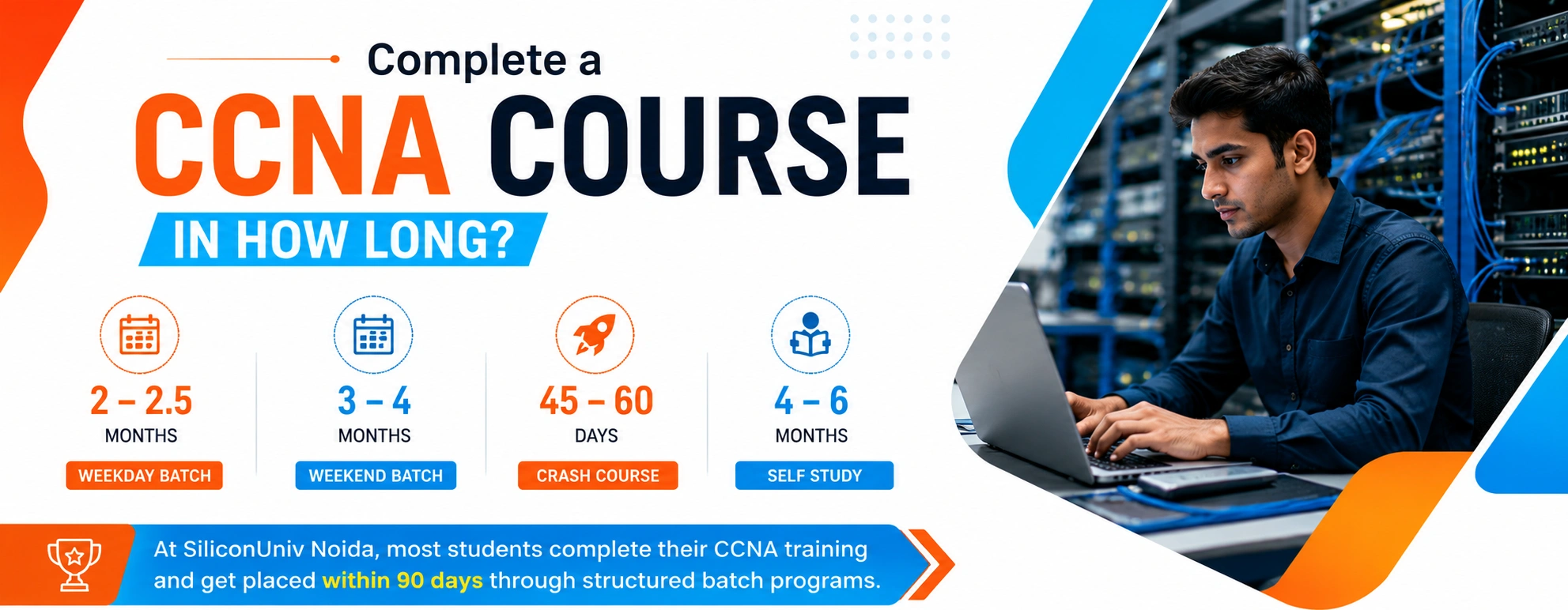
The time it takes to complete CCNA depends on how you study and which batch you choose. Most students in India complete their CCNA training in 2 to 3 months with consistent effort and daily practice.
|
Batch Type |
Duration |
|
Weekday Batch |
2 to 2.5 months |
|
Weekend Batch |
3 to 4 months |
|
Crash Course / Fast Track |
45 to 60 days |
|
Self Study Only |
4 to 6 months |
At SiliconUniv Noida, most students complete their CCNA training and get placed within 90 days through their structured batch programs.
Career Opportunities After CCNA
CCNA opens the door to some of the most in-demand jobs in the IT industry. Companies like TCS, Wipro, HCL, Infosys, IBM, and Cisco actively hire CCNA certified professionals across India. Here are the top career options available after CCNA —
Immediate Career Options After CCNA:
- Network Engineer: Configuring, maintaining, and managing physical and virtual network hardware.
- NOC Engineer: Monitoring large-scale enterprise network alerts and resolving live downtime issues.
- Network Administrator: Managing day-to-day operations, user access, and local network switches.
- IT Support Engineer: Handling escalated infrastructure troubleshooting beyond basic desktop support.
Advanced Careers You Can Transition into Later:
- Cloud Network Engineer: Specializing in connecting data centers to cloud platforms (AWS/Azure).
- Network Security Analyst: Focusing entirely on defending infrastructure using specialized firewalls.
- Network Consultant: Architecting customized networking systems for major corporate clients.
Benefits of Doing a CCNA Course
CCNA is not just a certificate — it is a career investment that pays back for years. Here are the key benefits of getting CCNA certified—
- Globally recognised certification valued by top employers worldwide
- Strong foundation for advanced certifications like CCNP and CCIE
- High demand across industries — banking, telecom, healthcare, and IT services
- Opens doors to cloud networking careers in AWS and Azure platforms
- Valid for 3 years with clear recertification path available
- Boosts your resume and makes you stand out in job interviews instantly
How Much Can You Earn After CCNA Certification?
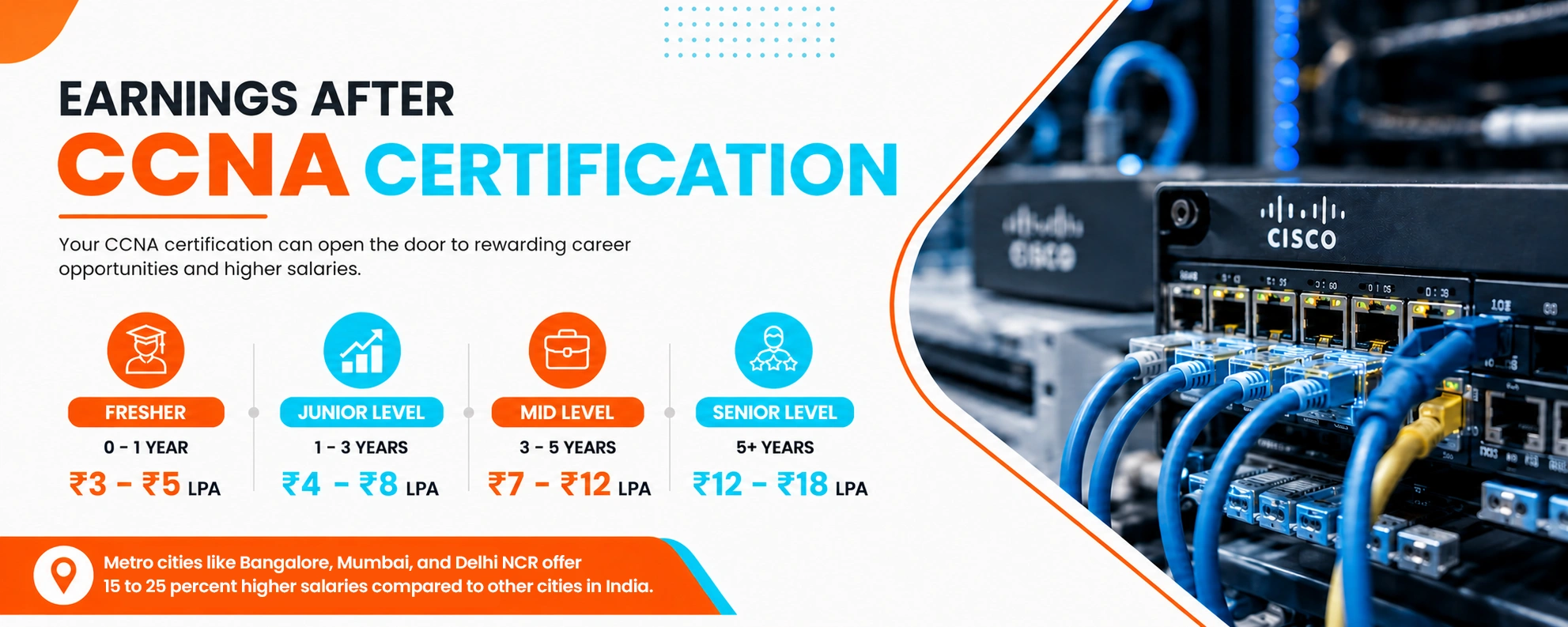
Salary after CCNA depends on your experience, city, and the company you work for. Here is a realistic salary guide for CCNA certified professionals in India in 2026 —
|
Level |
Experience |
Average Salary |
|
Fresher |
0 to 1 year |
₹3 LPA to ₹5 LPA |
|
Junior Level |
1 to 3 years |
₹4 LPA to ₹8 LPA |
|
Mid Level |
3 to 5 years |
₹7 LPA to ₹12 LPA |
|
Senior Level |
5 plus years |
₹12 LPA to ₹18 LPA |
Metro cities like Bangalore, Mumbai, and Delhi NCR offer 15 to 25 percent higher salaries compared to other cities in India.
How to Prepare for the CCNA Course
Preparing for CCNA the right way makes a huge difference. Here are five practical tips that will help you clear the exam with confidence —
- Build Networking Fundamentals: Before jumping into advanced topics, make sure your basics are strong. Understand how networks work, what the OSI model is, and how IP addressing works. A strong foundation makes everything else easier to understand and remember throughout the course.
- Practise Every Day: CCNA is not a course you can clear by reading alone. You need daily hands-on practice. Even 1 to 2 hours of daily practice on routers and switches will make a massive difference by the time your exam day arrives.
- Learn Through Labs: Real lab practice is what separates a good CCNA candidate from an average one. Use tools like Cisco Packet Tracer and GNS3 for simulation. Better still — join an institute like SiliconUniv that gives you 24/7 access to real routers and switches in their lab.
- Give Mock Exams: Begin taking mock tests at least 3-4 weeks prior to your actual exam. Mock exams help you get familiar with the exam format, pinpoint your weaknesses, and manage time better. You should be comfortably securing a 'Pass' status across all individual blueprint domains consistently before taking the actual test.
- Review Weak Topics: After every mock test, go back and review the topics where you made mistakes. Most students struggle with subnetting and OSPF configuration. Do not ignore weak areas — they are the ones that decide whether you pass or fail on exam day.
Is CCNA Worth It in 2026?
Yes, absolutely. Networks are the key to every business and there is no way things would change any time soon. There will be an ever-growing need for network engineers in India. Due to the rapid development of cloud computing, cybersecurity, and automation, there will be a need for people with in-depth knowledge of networks. And CCNA will give you just that.
Final Thoughts
If you have read this far, you already know that CCNA is a powerful certification that can genuinely change your career. It does not matter if you are a fresh graduate, a working professional, or someone looking to switch careers — CCNA gives everyone a fair chance to build something great in the IT world.
The most important thing is to start. Every networking expert you see today — every Network Engineer, every IT Manager — started exactly where you are right now. They just took the first step.
If you are in Noida or Delhi NCR and looking for the Best CCNA Institute to start your CCNA journey, SiliconUniv is the Best CCNA Training Institute with real lab access, certified trainers, and 100 percent placement support. Your networking career is one decision away.